Landless Moviment
After occupying land for decades, thousands of Brazilian families have the chance to put down roots
A government agreement redistributes once-privately owned land to 3,000 farming families and reflects a broader shift toward negotiated solutions in these types of disputes
By Marília Marasciulo
From Courthouse News
Geovane Cardoso was 7 years old when he and his family occupied part of the land owned by timber company Giacomet Marodin, later renamed Araupel, in Brazil’s southern state of Paraná.
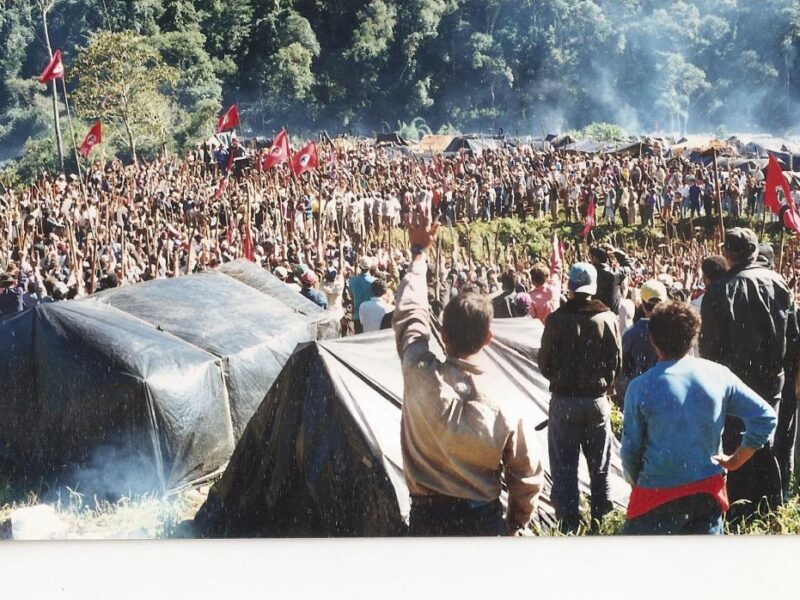
In the early hours of April 17, 1996, Cardoso, his parents and his eight siblings were among roughly 10,000 people who broke the lock on the gate of one of the largest estates in southern Brazil, marking the beginning of one of the state’s largest and longest-running land conflicts.
Cardoso’s father worked on a farm “in exchange for food and a pair of boots.” According to him, the company’s land in Rio Bonito do Iguaçu was “the bogeyman of the region,” as it was “strictly forbidden to enter the area,” at the risk of being shot by armed guards. “To carry out the occupation, we needed many families,” he said.
Movement leaders spent months gathering families in improvised encampments in the region before entering the land, in an effort to draw national attention to the conflict and make an immediate eviction by authorities more difficult.
The occupation gained national and international attention after Brazilian photographer Sebastião Salgado documented the encampments, producing a series of images that became widely known.
The years that followed were not easy. “I am a survivor of 1996,” Cardoso said. “It was very hard, there was little food. I spent 21 days in the hospital with anemia and malnutrition. Many children who would be my age today did not survive.”
Over time, some areas were turned into settlements, but much of the land remained under judicial dispute, with eviction orders, new encampments and negotiations dragging on for decades.

Nearly 30 years later, the conflict was resolved in January through an agreement between the companies and Brazil’s federal government. About 58,000 hectares (roughly 143,000 acres) will be allocated to the agrarian reform program, regularizing the situation of around 3,000 farming families already living on roughly 24,000 hectares (about 59,000 acres) and making the remaining land available for new settlements.
In return, the companies involved in the dispute — Araupel S.A. and its affiliate Rio das Cobras Ltda. — will receive 584 million reais (about $184 million) through federal court-ordered payments, and will retain ownership of 680 hectares (about 1,680 acres) for industrial activities and regional development.
“It is a historic moment in Brazil’s agrarian reform,” said Tarcísio Leopoldo, a leader of the Landless Workers’ Movement in Paraná. “It is unprecedented in the amount of land, the number of families involved and how the agreement was structured.”
Maíra Coraci, director of land acquisition at Brazil’s National Institute for Colonization and Agrarian Reform, said the conflict involved a series of lawsuits disputing ownership of parts of the area, as well as eviction claims filed by the companies against families occupying the land.
The negotiations began with an inspection to determine the value and legal status of different portions of the area. Based on that assessment, the agreement was structured so the government would pay for the portion deemed effectively private, while the companies acknowledged the remainder was public land.
In addition to the companies and the land reform agency, the process involved the Office of the Attorney General, the Ministry of Agrarian Development and representatives of the families occupying the area.
According to Coraci, a key factor that opened the door for negotiations was Resolution No. 510 issued by Brazil’s National Justice Council, which in 2023 created land conflict resolution commissions within courts and prioritizes mediation and dialogue in cases involving collective occupations before eviction orders are enforced.
The policy aims to avoid immediate evictions and encourage negotiated solutions in disputes involving vulnerable communities.

Leador Machado, director of mediation and conciliation for agrarian conflicts at the Ministry of Agrarian Development, said the agreement shows disputes of this kind can be addressed through institutional negotiation.
He said the conflict could have been settled much earlier if mechanisms created under Resolution 510 had already been in place, with the judiciary playing a central role in building agreements and coordinating solutions for complex land disputes.
“A negotiated solution can be reached without the situation escalating into violence,” Machado said. He added that the institutional model created by the National Justice Council is likely to remain in place regardless of changes in government, as the resolution is already embedded in the judiciary’s structure.
Brazil is among the countries with the highest number of killings of rural leaders, according to Chico Teixeira, a history professor at the Federal University of Rio de Janeiro and a leading scholar of the country’s agrarian history.
In 2024, Brazil recorded 2,185 rural conflicts, the second-highest figure since 1985, according to the latest report by the Pastoral Land Commission, one of the country’s leading organizations tracking land conflicts.
Thirteen people were killed that year, including five Indigenous people, three landless workers, two settlers, one small landowner, one squatter and one quilombola, a descendant of Afro-Brazilian enslaved people who escaped or were left behind and started settlements. Eight of the killings occurred in areas of agricultural expansion.
Teixeira said violence in the countryside is linked to a historically concentrated land structure in Brazil, marked by the predominance of large estates since the colonial period.
He noted agricultural expansion often occurs in areas contested by small farmers, traditional communities and Indigenous peoples, leading to recurring conflicts in regions where land is valued for export-oriented production.
“The model of colonization established in Brazil from the beginning is monocultural, based on large landholdings and on slavery,” he said.

Carlos Frederico Marés, a law professor at the Pontifical Catholic University of Paraná who specializes in agrarian law, said the historical origins of land concentration also help explain why land conflicts in Brazil often end up in court and can drag on for decades.
Much of the country’s rural property, he said, originated from irregular occupation processes that were later formally recognized by the state. This phenomenon, known in Brazil as “grilagem,” involves the appropriation of land through administrative fraud, court decisions or violence, contributing to the consolidation of large estates over time.
He said although Brazilian law provides mechanisms to limit land concentration and expropriate properties that fail to fulfill their social function, these tools are rarely applied in practice.
Court decisions and legal disputes over the past decades have created obstacles to the implementation of agrarian reform, he said, helping prolong land conflicts in the country. “It depends on the executive’s political will to carry out agrarian reform, but when there is political will, the judiciary creates obstacles,” he said.
While acknowledging that agreements like the one reached in Paraná can represent a definitive solution for prolonged land conflicts, Marés said such negotiations tend to involve high costs for the state and often benefit landowners.
The model, he said, effectively requires the government to pay for land whose ownership origins are often disputed. “If the judiciary ruled that the owner has no right because the title originated from land grabbing, the matter would be settled,” he said. “But the system ends up forcing agreements that benefit the landowner.”
Alberto Luchi, an administrative law attorney at São Paulo-based Arruda Alvim, said Brazil’s legal system allows negotiated agreements “even in matters involving public interests, where, in theory, public interest cannot be waived and would prevail over private interests.”
He said such arrangements can reduce costs for the state compared to traditional expropriation proceedings, which tend to drag on for years in court.
Still, Luchi added “this case is unfortunately an exception,” as “the vast majority of expropriation cases extend over time.”
“Right holders often die over the course of proceedings and their claims are passed on to heirs. There is also the budgetary issue, given that the Brazilian state has priority expenditures — health care, education, public security and public sector payroll — that require immediate payment,” he said. “But the resolution of a historic land conflict is certainly a good example to be followed in other ongoing cases.”

Coraci said that while the agreement has ended a decadeslong dispute, land regularization is only the first step. The challenge now is to ensure conditions for families to establish themselves permanently in the area.
“Families have been producing on that land for 20 years, but settlement is not automatic,” Coraci said. “They must go through a public selection process under agrarian reform rules. They receive a use concession, must work the land for at least 10 years to obtain title and must pay for it. There are several requirements.”
Leopoldo said the movement’s goal is not full land ownership but stable access to productive use through instruments such as use concessions, keeping the land under public ownership. He added that selection processes have incorporated social criteria, such as prioritizing female-headed households and encouraging youth participation in managing plots.
For Cardoso, who grew up in the occupation and now raises two children with his wife, the main expectation is access to credit, housing and schools.
“The school we have today is maintained by the students’ parents. We rely on subsistence farming and dairy cows that we built up over time without any public funding,” Cardoso said. “We are working to set up a cooperative and get the machinery we need. The hope is to raise our children so they develop a connection to this way of life and stay in the countryside.”
Courthouse News reporter Marília Marasciulo is based in Brazil.